This was what I performed at the Portsmouth DarkFest evening of Dark Town Port Town at the Araura cafe in Albert Road, Southsea.
Crows
When we finally reached the port of Dublin the crows that had been gathering throughout our journey were so many that the sky was black. At first sight, you could almost believe that it was past sunset, but my watch told me it was only mid-morning. We were glad to get on board the ferry, hoping to leave the dark flock behind. The boat was filled with tourists - Germans, Americans, English, as well as lorry drivers from all over Europe.
Through the lounge window I could see a lone jogger, running in the gloom along the length of the harbour causeway, almost as though he was racing us as the Ferry slowly moved out into the open sea. I feared for his safety, out there alone, under the sky filled with crows and wondered, not for the first time, why the collective noun for crows is ‘a murder’. Then the cloud seemed to funnel down as a group flocked around the jogger. He struggled to reach the lighthouse which marked the entrance to the port. I watched him fighting off the vicious birds - it was impossible - there were too many. Looking away for a moment, feeling sick, when I looked back, he was gone from view. Perhaps it was just in my imagination - I looked around at the other passengers but no-one else seemed concerned at all, each wrapped up in their own conversations which seemed to get louder and louder.
Four hours later, having crossed the Irish Sea, leaving behind what I’d convinced myself was, in fact, a dream - a nightmare brought on by the long journey which had taken us to Dublin overnight, we docked in Holyhead. We disembarked ahead of the other passengers, smug on the motorcycle which was so much more easy to travel on than in a car and rode swiftly out into the countryside, making our way to Liverpool.
The wind in my face as we rode across North Wales blew away any trace of the nightmare and when the sun came out, all seemed perfect again.
There’s nothing like fish and chips by the seaside. When we stopped at Rhyl we left our crash helmets on the bike and sat on the promenade. The evening sun was still warm, the cool breeze from the sea welcome. We unwrapped out chips as we gazed out at the horizon. In the distance I could see what I thought was a tanker but as I watched it seemed to grow. “It’s moving too fast for a tanker,” I said.
“What’s that?” asked Mark, taking his attention away from his crispy batter. I pointed.
“Bloody Hell, that’s weird,” he said.
And it was, terrifyingly weird. As it grew closer, a chill settled in my stomach - I had seen this before. Moving so fast and heading towards the shore where we sat - the crows! I dropped my chips and struggled to get to my feet. I ran, clumsily in motorcycle trousers, not made for ease of movement. Mark grabbed my hand and dragged me along. We stumbled and I found myself falling - off the promenade and onto the shingle beach. Still, he pulled me up and pushing, and pulling now, we managed to find ourselves under the pier. For some strange quirk of fate, the birds swooped straight overhead, missing us as they headed inland. We noticed the sky was lightening. They had gone.
Still shaken, we held each other, wondering what awful twist of nature had caused the crows to act like this. But we needed to get home. The prospect of another week travelling on the bike had lost its appeal and we could be home in a few hours, so we abandoned our plans, got on the bike and made for the motorway to Portsmouth.
Again, being on the bike, riding through the peace of the countryside, helped to push away thoughts of what had happened. After a few miles, it all seemed again like a bad dream. I knew I had a vivid imagination so perhaps this was just another of my stories, conjured up for amusement.
There’s nothing as good as arriving back in Portsmouth after being away. Riding to the top of Portsdown Hill, it’s always nice to pause and look down at our home, something that always lifts the spirits. It was dark by the time we reached this point and as we paused, we looked down at the myriad of lights that is Portsmouth at night. We didn’t notice the black patch of darkness at first, then we saw that it was moving, moving slowly over the island city, as though looking for something, searching, searching across the rooftops of our home.
Making our way down the hillside, and then across the island to Southsea, I wondered what the hell was happening, but it was when we arrived at the end of our street that I knew we could never go home. A massive cloud of crows had settled across the whole of the road, covering the houses, the walls and all of the vehicles parked in the street. In the darkness, I heard nothing but the rustle of feathers as wings shifted and settled for the night. Then, a quiet whimpering, the sound of a child’s nightmare, I thought, but no, it was moving towards us along the pavement - a figure, completely covered in those huge black birds.
Sunday, 12 November 2017

Friday, 10 November 2017
Day of the Dead V @ Portsmouth DarkFest
This was what I performed at Day of the Dead last week. Unusually for me, I recycled this one from the recent Gosport Steampunk Festival where it was performed to a small but select audience:
Jake the SteamPunk
I wouldn’t want it to get out but I’m not really a Steampunk. Don’t get me wrong, the dressing up is fun and I quite like the fantasy side of it. It’s just that - well, this is my story...
I met Jake on the Isle of Wight Ferry last year. He was on his way to the Pirate Festival and I was going to the revival event at Havenstreet, dressed in my smartest 1940s outfit, complete with hat and gloves and he, well he was dressed in a bizarre collection of Victorian frock-coat, leather waistcoat with chains looped all over it, a pair of what looked like biker boots, a top hat with goggles attached, and he carried a pistol! It was the pistol that did it for me. There was an instant attraction, that’s for sure. He stared at me with his one eye - the other was covered with a patch. It wasn’t obvious whether this was part of his costume or a functional necessity. Then he grinned, showing me his beautiful white teeth as he offered to buy me a drink in the bar.
The ferry was crowded and we were jostled together in the melee of people - pirates, Steampunks and Second World War re-enactors. Oh, and there were a few holiday makers on their way too, excited children and pissed-off parents, all wishing that they were already at their destination.
We parted when the ferry docked at Cowes, each totally out of synchronicity with the other’s destination but we did exchange phone numbers and over the next few months embarked on a steamy love affair. I won’t go into details here - let’s just say I was hooked on his pistol and he just loved my 1940s stockings and the lacy gloves.
It had all been going so well until he introduced me to his submarine. Not your run of the mill sub, oh no, it was something that he’d built in his garden shed. In fact, it was still in his garden shed when he introduced me, enticing me to slide in through the hatch to experience the true Steam-Punk adventure. He said it would be our own fantasy voyage to the bottom of the sea. I have to admit that I was concerned about getting a ladder - authentic 1940s stockings are not easy to find - and I wasn’t sure about being incarcerated in this contraption although the fantasy aspect of the voyage did appeal to me at the time.
It was cosy. We lay side by side, the buckles on his boots digging into my thighs as I wondered what would happen next. After all, there’s not a lot you can do without being able to move about much. That’s what I thought anyway and maybe with hindsight, it would have been better not to have tried.
The problem began when I got cramp. Well, you know what it’s like when you get cramp in bed? Your leg starts to jerk and you just have to sit up. Of course, there was no sitting up in the submarine and the fact that it was only built for one didn’t help. I did thrash about - and I made a lot of noise, quite a lot as it happens so I didn’t notice the gunshot. Nor did I notice that Jake had gone very quiet until the cramp died away and I could turn my attention back to him.
There was so little space in our cocoon that it was difficult even to turn on my side to look at him properly. His eyes were open but they seemed a little glazed. ‘Oh, dear,’ I thought.
I had a bit of a job but finally managed to wriggle out through the hatch and once out, I could see more clearly from above that he was not in a good state at all. In fact, I believe he was dead.
I’m still not sure why he was carrying a loaded pistol but that was what ‘did him in’ in the end. I was very fond of him and was reluctant to end our affair, so I gently closed the hatch of the submarine and left him there whilst I went away to think.
What could I do? He was dead, after all. He’d previously told me that he had no family as such, just an Aunt in South Africa that he hadn’t seen in years. So no-one would be likely to come round to visit. Apparently, none of his Steam Punk friends visited him. He had kept himself to himself, not encouraging close friendships. It did seem rather strange to me when he told me that, although now I realise that it was a bit of a Godsend because I could have him all to myself without any interference from anyone else.
The submarine, his tomb, was very warm and soon the whole shed was rather smelly. I decided to help things along a bit. Luckily, he had one of those ‘Wormeries’ or whatever they’re called, just outside of the shed and a few scoops of that, together with the worms into the hatch of the sub helped to speed up the natural process of decay. I left it alone after that, but the other day, when preparing for this event, I popped in for a quick look and lo and behold, there was Jake, grinning up at me, showing all of his lovely white teeth.
Jake the SteamPunk
I wouldn’t want it to get out but I’m not really a Steampunk. Don’t get me wrong, the dressing up is fun and I quite like the fantasy side of it. It’s just that - well, this is my story...
I met Jake on the Isle of Wight Ferry last year. He was on his way to the Pirate Festival and I was going to the revival event at Havenstreet, dressed in my smartest 1940s outfit, complete with hat and gloves and he, well he was dressed in a bizarre collection of Victorian frock-coat, leather waistcoat with chains looped all over it, a pair of what looked like biker boots, a top hat with goggles attached, and he carried a pistol! It was the pistol that did it for me. There was an instant attraction, that’s for sure. He stared at me with his one eye - the other was covered with a patch. It wasn’t obvious whether this was part of his costume or a functional necessity. Then he grinned, showing me his beautiful white teeth as he offered to buy me a drink in the bar.
The ferry was crowded and we were jostled together in the melee of people - pirates, Steampunks and Second World War re-enactors. Oh, and there were a few holiday makers on their way too, excited children and pissed-off parents, all wishing that they were already at their destination.
We parted when the ferry docked at Cowes, each totally out of synchronicity with the other’s destination but we did exchange phone numbers and over the next few months embarked on a steamy love affair. I won’t go into details here - let’s just say I was hooked on his pistol and he just loved my 1940s stockings and the lacy gloves.
It had all been going so well until he introduced me to his submarine. Not your run of the mill sub, oh no, it was something that he’d built in his garden shed. In fact, it was still in his garden shed when he introduced me, enticing me to slide in through the hatch to experience the true Steam-Punk adventure. He said it would be our own fantasy voyage to the bottom of the sea. I have to admit that I was concerned about getting a ladder - authentic 1940s stockings are not easy to find - and I wasn’t sure about being incarcerated in this contraption although the fantasy aspect of the voyage did appeal to me at the time.
It was cosy. We lay side by side, the buckles on his boots digging into my thighs as I wondered what would happen next. After all, there’s not a lot you can do without being able to move about much. That’s what I thought anyway and maybe with hindsight, it would have been better not to have tried.
The problem began when I got cramp. Well, you know what it’s like when you get cramp in bed? Your leg starts to jerk and you just have to sit up. Of course, there was no sitting up in the submarine and the fact that it was only built for one didn’t help. I did thrash about - and I made a lot of noise, quite a lot as it happens so I didn’t notice the gunshot. Nor did I notice that Jake had gone very quiet until the cramp died away and I could turn my attention back to him.
There was so little space in our cocoon that it was difficult even to turn on my side to look at him properly. His eyes were open but they seemed a little glazed. ‘Oh, dear,’ I thought.
I had a bit of a job but finally managed to wriggle out through the hatch and once out, I could see more clearly from above that he was not in a good state at all. In fact, I believe he was dead.
I’m still not sure why he was carrying a loaded pistol but that was what ‘did him in’ in the end. I was very fond of him and was reluctant to end our affair, so I gently closed the hatch of the submarine and left him there whilst I went away to think.
What could I do? He was dead, after all. He’d previously told me that he had no family as such, just an Aunt in South Africa that he hadn’t seen in years. So no-one would be likely to come round to visit. Apparently, none of his Steam Punk friends visited him. He had kept himself to himself, not encouraging close friendships. It did seem rather strange to me when he told me that, although now I realise that it was a bit of a Godsend because I could have him all to myself without any interference from anyone else.
The submarine, his tomb, was very warm and soon the whole shed was rather smelly. I decided to help things along a bit. Luckily, he had one of those ‘Wormeries’ or whatever they’re called, just outside of the shed and a few scoops of that, together with the worms into the hatch of the sub helped to speed up the natural process of decay. I left it alone after that, but the other day, when preparing for this event, I popped in for a quick look and lo and behold, there was Jake, grinning up at me, showing all of his lovely white teeth.
Wednesday, 8 November 2017
Portsmouth Darkfest
My feet haven't touched the ground yet. It's only the 8th November and we are well into Darkfest. This past two weeks have seen me performing in three events and I still have a couple more to come in November.
My favourite so far has been The Cure, The Cure at Southsea Castle on the 26th October. Great fun dressing up as a plague doctor and performing in front of a fantastic light/video show to a very welcoming audience.
This is what I performed:
Mercury - The ultimate cure
I’ve always wanted to help people. When I was young I knew that I was born to heal. Of course, being a woman, it wasn’t possible for me to study the healing arts in the same way as a man could. But I spent time in the shadow of the midwife, watching and assisting her in birthing and with the dying.
“Death is a natural part of Life,” she would say, and there was much birthing and much dying in our town. I learnt aplenty. I’ve seen many of the fevers and pestilences that are common everywhere. I believed I was charmed because however close I got to those who were suffering, I always seemed to escape from any malady myself.
But because I was a woman, I was shunned by men in the profession. Doctors looked down their noses at me, called me witch and said it was unnatural.
My Father being a well-respected Parson, taught me to read, but disapproved of my desire to heal the poor so I hid what I was doing by pretending that I was ministering to the peasants, taking them scraps of food as was appropriate and only right from the daughter of a man of religion. Mother died when I was born and perhaps this was why I had such a desire to heal the sick.
It was frustrating having to hide what I was doing. Gathering herbs and plants from the meadows and marshes, drying and grinding them into remedies was time consuming. Seeing the benefit of what I was learning when I tried out the concoctions on my patients was satisfying to a degree. Only I wished that I could be open about what I was doing rather than having to keep secret all that I had learnt. I stole a book that was left on the table in the Rectory after my Father had been entertaining a medic friend and this book became my Bible. Hidden in a box under my bed, I would take it out at night and study the pages until my eyes were sore. I soon was able to try out more and more remedies. People came to me secretly, no one wanting to be associated with a woman healer. Father would not have understood.
Then came the Plague.
The Doctors tried everything they knew: poultices of onion and butter with a sprinkling of dried frog, arsenic or floral compounds, bloodletting, inducing diarrhea to relieve the body of invading demons. It seemed that nothing worked and soon the Doctors, one by one, faded away, either by succumbing themselves to the deadly disease, or leaving town for the safety of the country. Even when dressed in their protective robes, they were not safe from death, so they went, leaving us poor town folk to the mercy of the devil that was the Plague.
For me, it was my chance. I believed I could help where they had not, and when donned in the robes and mask of the Plague Doctor, I could be anonymous; no-one would know who I was, nor my fair sex. I needed not to even touch the patient, my cane would suffice to remove the covers so that I could inspect their frail bodies.
I witnessed all stages of this foul disease, saw the look of fear in the eyes of those inflicted when they found the blackened buboes in their armpits. I had seen how leeching these swellings did nothing to stop how swiftly they spread throughout the body until the poor soul’s skin turned black, they bled from the mouth and fell into a stupor, the only outcome of which was death.
None of the cures worked. It seemed as though it was only the hand of God that decided who was to live and who was to die. And yes, some did survive, only it was impossible to see why one person lived and another was doomed to hell.
It was on the morning, after a long night of study, that I discovered two things: firstly, the new treatment of Mercury painting, and secondly, that I was suffering from the first sign of the disease - fever and chills like I have never before experienced. I obtained the Mercury from my Father’s office - it had, in the past been used as a store for the local medical man and I had often filched supplies from there before. I had read that it was to be made into a paste using a base of flour and mixed with water. Simple, I thought. It was hard going as I was feeling weaker as time passed but soon it was ready. Next I had to make sure that the bread oven was fired up and hot enough to complete the process.
“Cover the infected body with Mercury paste, then bake in the oven until a crust is formed.” These were the instructions that I followed. When I climbed into the oven, I hadn’t expected it to be so painful, but the heat certainly killed the Plague. Feeling the flames licking over me was almost a relief. I closed my eyes and let the ultimate cure take place.
My favourite so far has been The Cure, The Cure at Southsea Castle on the 26th October. Great fun dressing up as a plague doctor and performing in front of a fantastic light/video show to a very welcoming audience.
This is what I performed:
Mercury - The ultimate cure
I’ve always wanted to help people. When I was young I knew that I was born to heal. Of course, being a woman, it wasn’t possible for me to study the healing arts in the same way as a man could. But I spent time in the shadow of the midwife, watching and assisting her in birthing and with the dying.
“Death is a natural part of Life,” she would say, and there was much birthing and much dying in our town. I learnt aplenty. I’ve seen many of the fevers and pestilences that are common everywhere. I believed I was charmed because however close I got to those who were suffering, I always seemed to escape from any malady myself.
But because I was a woman, I was shunned by men in the profession. Doctors looked down their noses at me, called me witch and said it was unnatural.
My Father being a well-respected Parson, taught me to read, but disapproved of my desire to heal the poor so I hid what I was doing by pretending that I was ministering to the peasants, taking them scraps of food as was appropriate and only right from the daughter of a man of religion. Mother died when I was born and perhaps this was why I had such a desire to heal the sick.
It was frustrating having to hide what I was doing. Gathering herbs and plants from the meadows and marshes, drying and grinding them into remedies was time consuming. Seeing the benefit of what I was learning when I tried out the concoctions on my patients was satisfying to a degree. Only I wished that I could be open about what I was doing rather than having to keep secret all that I had learnt. I stole a book that was left on the table in the Rectory after my Father had been entertaining a medic friend and this book became my Bible. Hidden in a box under my bed, I would take it out at night and study the pages until my eyes were sore. I soon was able to try out more and more remedies. People came to me secretly, no one wanting to be associated with a woman healer. Father would not have understood.
Then came the Plague.
The Doctors tried everything they knew: poultices of onion and butter with a sprinkling of dried frog, arsenic or floral compounds, bloodletting, inducing diarrhea to relieve the body of invading demons. It seemed that nothing worked and soon the Doctors, one by one, faded away, either by succumbing themselves to the deadly disease, or leaving town for the safety of the country. Even when dressed in their protective robes, they were not safe from death, so they went, leaving us poor town folk to the mercy of the devil that was the Plague.
For me, it was my chance. I believed I could help where they had not, and when donned in the robes and mask of the Plague Doctor, I could be anonymous; no-one would know who I was, nor my fair sex. I needed not to even touch the patient, my cane would suffice to remove the covers so that I could inspect their frail bodies.
I witnessed all stages of this foul disease, saw the look of fear in the eyes of those inflicted when they found the blackened buboes in their armpits. I had seen how leeching these swellings did nothing to stop how swiftly they spread throughout the body until the poor soul’s skin turned black, they bled from the mouth and fell into a stupor, the only outcome of which was death.
None of the cures worked. It seemed as though it was only the hand of God that decided who was to live and who was to die. And yes, some did survive, only it was impossible to see why one person lived and another was doomed to hell.
It was on the morning, after a long night of study, that I discovered two things: firstly, the new treatment of Mercury painting, and secondly, that I was suffering from the first sign of the disease - fever and chills like I have never before experienced. I obtained the Mercury from my Father’s office - it had, in the past been used as a store for the local medical man and I had often filched supplies from there before. I had read that it was to be made into a paste using a base of flour and mixed with water. Simple, I thought. It was hard going as I was feeling weaker as time passed but soon it was ready. Next I had to make sure that the bread oven was fired up and hot enough to complete the process.
“Cover the infected body with Mercury paste, then bake in the oven until a crust is formed.” These were the instructions that I followed. When I climbed into the oven, I hadn’t expected it to be so painful, but the heat certainly killed the Plague. Feeling the flames licking over me was almost a relief. I closed my eyes and let the ultimate cure take place.
Wednesday, 10 August 2016
Motor Cycling in Northern Spain and Portugal
Three years ago, we travelled to Northern Spain and Portugal on the BMW GS with a group of bikers. We had a wonderful time and this year decided to revisit the experience. We toured with Global Motorcycle Tours, having gone with the Company three times before to various locations in Europe. Northern Spain and Portugal remain our favourites even though this year's journey was quite a different kettle of fish.


When we join these tours, we like to get to know everyone else in the group. Usually consisting of about fifteen bikes with a mix of singles and couples, most of the singles are male, so it's good to have at least five or six couples involved. Mark and I are 'people loving people' and part of the holiday for us is chatting to everyone, finding out a little about each person and hopefully making some new good friends. It's always interesting to see the vast range of characters who get into biking. In the past we have met musicians, nurses, teachers, oil-field engineers, surgeons, chief executives, metal workers, hotel proprietors, bus drivers, to name but a few. Once on a motor bike, there is no difference - the bike is the leveller, the link between all.


But of course, the real holiday is the tour. Riding on roads that sweep and wind through mountain passes or across open plains with little traffic is a joy. When the weather is warm, there is nothing like being on a motorbike, the breeze in your face, the smells of the countryside herbs or cattle changing to odours of civilisation as you approach a town. The aromas of newly baked bread, or roasting meat waft fleetingly through your senses together with the traffic of the busy streets. Then back out into the countryside again, watching storks standing in mown meadows, the sight of men working in the fields, scything the grass in preparation for next winter's fodder. The sound of the bells on mountain goats whilst you wait patiently for a flock of sheep to be herded across the road by an old bored-looking sheep dog.
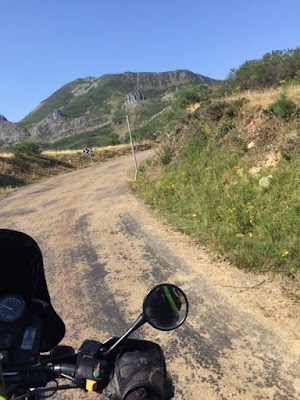

Riding in a group with fourteen other bikes is an experience in itself. After a day or so, you find yourself bonding as a group, thinking like a group, looking out for each other. If one of the group have a mishap everyone feels it. Sometimes, as in all groups, there are people that you don't feel so comfortable around and this for me, is part of the adventure. But they are still a part of the group and because of this, each time we go on a tour it is different.
People tell me that being a pillion on a motorbike is dangerous and that maybe I shouldn't be putting my life at risk for such a pastime. This year's tour in Spain and Portugal did bring home to me just how dangerous it can be. Anyone can come off a bike, even the most careful of riders, and I have always been aware of that fact. However I have always been confident that my partner is a competent rider who would not take risks, especially not with me on the back, and not in such a situation as whilst on a tour like this.


It was only on the second day, the first full day of the tour, when one of the group had an accident and came off on a bend. We were riding towards the middle of the group which had strung out over several miles when the tour leader pulled up, led us into a shady spot and told us that one of the riders had come off. We knew nothing more at this point as he left us with his partner and went back to investigate. We waited in the limited shade for news. He kept us fully informed and within an hour or so, the rider was on his way to hospital, extremely lucky to have survived what could have been a nasty outcome. A more subdued party arrived at the hotel that evening. You will always get riders who take perhaps more risks than is necessary and I imagine that after riding on English roads, suddenly arriving in a country where the highways seem to be made for bikers to enjoy, it is easy to forget how dangerous some of the roads can be.

There was much talk in the bar that night and it made me think about how much responsibility we each have towards the group in these situations. You pay for a holiday adventure and perhaps you feel that it's no one's business but your own how you experience that holiday, but if you are in a group such as this, what you do and how you behave has an effect on the group. Luckily for the rider involved, he had only fairly minor injuries - but it was a close call and certainly affected the way others behaved after the event. For me, I saw how well we were all looked after by the tour leaders who ensured that everything for the rider who came off was put into place without a hitch, as well as keeping us all updated on progress from the moment of the accident to the end of the tour eight days later. They worked hard to keep the morale of the group on a level so that we could still enjoy our holiday whilst being aware of lessons which may have been learned by this incident. Some people may say that going on a 'guided' tour is an expensive way to travel on holiday but I can honestly say that the tour leaders earned their money on this tour.
We certainly recommend this company for a superb range of tours in Europe for those who wish to combine a great holiday with an adventure. Certainly not for the faint-hearted but great fun. Run by Tom and Susan Bennett.

www.globalmotorcycletours.co.uk
Facebook page: Global Touring UK Motorcycle Tours
This Tour was the Northern Spain & Portugal Tour which covered Picos de Europa, the Peneda-Geres National Park in Portugal, the Serra Da Estrela National Park, and included a visit to the Sandemans Quinta do Seixo vineyard.


When we join these tours, we like to get to know everyone else in the group. Usually consisting of about fifteen bikes with a mix of singles and couples, most of the singles are male, so it's good to have at least five or six couples involved. Mark and I are 'people loving people' and part of the holiday for us is chatting to everyone, finding out a little about each person and hopefully making some new good friends. It's always interesting to see the vast range of characters who get into biking. In the past we have met musicians, nurses, teachers, oil-field engineers, surgeons, chief executives, metal workers, hotel proprietors, bus drivers, to name but a few. Once on a motor bike, there is no difference - the bike is the leveller, the link between all.


But of course, the real holiday is the tour. Riding on roads that sweep and wind through mountain passes or across open plains with little traffic is a joy. When the weather is warm, there is nothing like being on a motorbike, the breeze in your face, the smells of the countryside herbs or cattle changing to odours of civilisation as you approach a town. The aromas of newly baked bread, or roasting meat waft fleetingly through your senses together with the traffic of the busy streets. Then back out into the countryside again, watching storks standing in mown meadows, the sight of men working in the fields, scything the grass in preparation for next winter's fodder. The sound of the bells on mountain goats whilst you wait patiently for a flock of sheep to be herded across the road by an old bored-looking sheep dog.


Riding in a group with fourteen other bikes is an experience in itself. After a day or so, you find yourself bonding as a group, thinking like a group, looking out for each other. If one of the group have a mishap everyone feels it. Sometimes, as in all groups, there are people that you don't feel so comfortable around and this for me, is part of the adventure. But they are still a part of the group and because of this, each time we go on a tour it is different.
People tell me that being a pillion on a motorbike is dangerous and that maybe I shouldn't be putting my life at risk for such a pastime. This year's tour in Spain and Portugal did bring home to me just how dangerous it can be. Anyone can come off a bike, even the most careful of riders, and I have always been aware of that fact. However I have always been confident that my partner is a competent rider who would not take risks, especially not with me on the back, and not in such a situation as whilst on a tour like this.


It was only on the second day, the first full day of the tour, when one of the group had an accident and came off on a bend. We were riding towards the middle of the group which had strung out over several miles when the tour leader pulled up, led us into a shady spot and told us that one of the riders had come off. We knew nothing more at this point as he left us with his partner and went back to investigate. We waited in the limited shade for news. He kept us fully informed and within an hour or so, the rider was on his way to hospital, extremely lucky to have survived what could have been a nasty outcome. A more subdued party arrived at the hotel that evening. You will always get riders who take perhaps more risks than is necessary and I imagine that after riding on English roads, suddenly arriving in a country where the highways seem to be made for bikers to enjoy, it is easy to forget how dangerous some of the roads can be.

There was much talk in the bar that night and it made me think about how much responsibility we each have towards the group in these situations. You pay for a holiday adventure and perhaps you feel that it's no one's business but your own how you experience that holiday, but if you are in a group such as this, what you do and how you behave has an effect on the group. Luckily for the rider involved, he had only fairly minor injuries - but it was a close call and certainly affected the way others behaved after the event. For me, I saw how well we were all looked after by the tour leaders who ensured that everything for the rider who came off was put into place without a hitch, as well as keeping us all updated on progress from the moment of the accident to the end of the tour eight days later. They worked hard to keep the morale of the group on a level so that we could still enjoy our holiday whilst being aware of lessons which may have been learned by this incident. Some people may say that going on a 'guided' tour is an expensive way to travel on holiday but I can honestly say that the tour leaders earned their money on this tour.
We certainly recommend this company for a superb range of tours in Europe for those who wish to combine a great holiday with an adventure. Certainly not for the faint-hearted but great fun. Run by Tom and Susan Bennett.

www.globalmotorcycletours.co.uk
Facebook page: Global Touring UK Motorcycle Tours
This Tour was the Northern Spain & Portugal Tour which covered Picos de Europa, the Peneda-Geres National Park in Portugal, the Serra Da Estrela National Park, and included a visit to the Sandemans Quinta do Seixo vineyard.
Friday, 27 May 2016
A Journey Home
A couple of months ago, Mark and I took a trip to Poland. The first time for both of us, but for myself, it had a greater meaning. Apologies to my brothers who may have different memories. This is just my own.....
A Journey Home
The plane banked, ready to descend from the sky. The bright sunlight beaming through the tiny cabin windows dimmed as we dipped into the cloud. I looked at my husband, he took my hand and held it in his. I glanced through the window once more and there it was - Poland. Miles and miles of dark forest and pale green fields sweeping below us. The tears flowed without even a thought of what we were doing or where we were. It was automatic, embarrassing, as I had no control over the emotions. Why had it taken so long to get to this point in my life, I wondered. I don’t know the answer but it felt like I was coming home at last.
In 1945, at the end of the war, thousands of Polish soldiers arrived in England. Given the choice of settling here, going to the USA, or returning home to Poland, many decided to stay here. The Soviet Union having ‘liberated’ the area where my Father had come from made going home a poor choice at the time, although leaving behind his sick Mother left him carrying a guilt for the rest of his life. Before long he met the woman who was to become my own Mother and soon they were married with a child on the way.
Life was hard in England in the years after the war. My Father had little education in Poland due to the German occupation. Polish citizens were treated no better than slaves and children had to leave school at a very young age. Now a free man with a new life here but with no trade or profession, he was a labourer for several years, working on projects such as the Fawley Oil Refinery. My parents lived in a number of different homes in the early years: a period of time with my Nan, some time in a converted church in Fareham, and at the time that I was born, in a Nissen hut which had previously been used by prisoners of war.
I was still a toddler when we moved into our council house, newly built at the time. Money was still very tight and I remember going with my Mother to jumble sales for new clothes and being given hand-me-downs from the woman my Nan worked for as a cleaner. Her daughter had only the best so my clothes were often of good quality and lasted well.
During all those years of growing up sometimes Dad would tell us stories of his childhood in Poland. There was always a sadness in his tales as they were tinged with the knowledge that he would never go back to his homeland. There was this little obstacle at the time - the Iron Curtain.
As we grew and the years passed, my Father was persuaded to train as a psychiatric nurse. This was mainly due to my Mother who had always loved nursing and though she’d not completed her training before the children started to come along, she was working as a nursing assistant at nearby Knowle Hospital and, worried that labouring outside in all weathers was affecting my Father’s health, she talked him into giving it a go. He loved it and had a successful career in nursing.
When travel between the West and East became easier, in the 1980s, I finally met my Uncle and Aunt who lived in Poland - they came to visit us - my Father still would not, or could not go back to Poland for a visit. The country remained under the Communist rule then and although some travel to the West was allowed, it was difficult and our relatives advised us not to go.
My Father died over 12 years ago and had never been back to Poland. Since his death, more and more Polish people have come to England and many have settled in Portsmouth. Suddenly, everywhere I go in town, I hear my Father’s voice - in cafes, supermarkets, on the streets. It’s somehow comforting.
When the plane landed in Katowize and we left the airport, it was uncanny. The people who greeted us, whilst strangers, were so familiar to me. The journey from the airport to Krakow, through country where my Father would have possibly played and then fought during the war years, starving and cold in the winters with no fuel or money for food, played on my emotions. For all of my life to this moment, Poland had been a distant land, a fairy tale of my childhood, a place I thought I would never see apart from in stories and in my dreams. And yet, here I was, bumping along in a mini-bus, peering through rain-washed windows at the land of my family. These forests where my Father may have picnicked and gathered wild mushrooms, these towns where my Father may have visited distant relatives that I would never meet, the new roads which were not there when my Father was a child, roads he had never seen.
Krakow is a magnificent city, it’s market square boasting to be the largest in Europe, it’s history rich and varied. It’s people are proud of their heritage and I could not find a trace of bitterness linked to their past. Just a determination to remain free and to make Poland a great nation again. For me, everywhere we went, I could hear my Father’s voice, my Aunt’s laughter and kindness. The people are gentle, courteous, and hard working. I felt truly at home.
For many tourists going to Krakow, it’s important to visit Auschwiz and Berkenhau, to remind us all of what we, as humans are capable of. For myself, it was chilling to think that there but for the grace of something, my Father might have ended his days there. A tour of the Jewish Quarter and Schindler’s factory, now a museum dedicated to the Jews of Krakow is equally harrowing. But the highlight of the visit was the free walking tour of Krakow Old Town. You can find their details online at www.freewalkingtour.com/calendar. Our leader, a young woman called Gosia, was enthusiastic, highly knowledgeable and sensitive as she led us through the highlights and history of Krakow Old Town. It is recommended that you wear good walking shoes and as our trip was in early March, we needed raincoats and warm clothing. The tour took a couple of hours and was a whirlwind of emotions for me. We came away with a deeper understanding of Polish people. I felt I had found my true roots.
We only stayed in Krakow for a few days. It was enough for me for the first visit but we left with wonderful memories and the knowledge that I’d completed a part of the jig-saw that is me, reconnecting with the past, even though I have no family left in Poland.
The journey home to England was simply a journey from home to home.
A Journey Home
The plane banked, ready to descend from the sky. The bright sunlight beaming through the tiny cabin windows dimmed as we dipped into the cloud. I looked at my husband, he took my hand and held it in his. I glanced through the window once more and there it was - Poland. Miles and miles of dark forest and pale green fields sweeping below us. The tears flowed without even a thought of what we were doing or where we were. It was automatic, embarrassing, as I had no control over the emotions. Why had it taken so long to get to this point in my life, I wondered. I don’t know the answer but it felt like I was coming home at last.
In 1945, at the end of the war, thousands of Polish soldiers arrived in England. Given the choice of settling here, going to the USA, or returning home to Poland, many decided to stay here. The Soviet Union having ‘liberated’ the area where my Father had come from made going home a poor choice at the time, although leaving behind his sick Mother left him carrying a guilt for the rest of his life. Before long he met the woman who was to become my own Mother and soon they were married with a child on the way.
Life was hard in England in the years after the war. My Father had little education in Poland due to the German occupation. Polish citizens were treated no better than slaves and children had to leave school at a very young age. Now a free man with a new life here but with no trade or profession, he was a labourer for several years, working on projects such as the Fawley Oil Refinery. My parents lived in a number of different homes in the early years: a period of time with my Nan, some time in a converted church in Fareham, and at the time that I was born, in a Nissen hut which had previously been used by prisoners of war.
I was still a toddler when we moved into our council house, newly built at the time. Money was still very tight and I remember going with my Mother to jumble sales for new clothes and being given hand-me-downs from the woman my Nan worked for as a cleaner. Her daughter had only the best so my clothes were often of good quality and lasted well.
During all those years of growing up sometimes Dad would tell us stories of his childhood in Poland. There was always a sadness in his tales as they were tinged with the knowledge that he would never go back to his homeland. There was this little obstacle at the time - the Iron Curtain.
As we grew and the years passed, my Father was persuaded to train as a psychiatric nurse. This was mainly due to my Mother who had always loved nursing and though she’d not completed her training before the children started to come along, she was working as a nursing assistant at nearby Knowle Hospital and, worried that labouring outside in all weathers was affecting my Father’s health, she talked him into giving it a go. He loved it and had a successful career in nursing.
When travel between the West and East became easier, in the 1980s, I finally met my Uncle and Aunt who lived in Poland - they came to visit us - my Father still would not, or could not go back to Poland for a visit. The country remained under the Communist rule then and although some travel to the West was allowed, it was difficult and our relatives advised us not to go.
My Father died over 12 years ago and had never been back to Poland. Since his death, more and more Polish people have come to England and many have settled in Portsmouth. Suddenly, everywhere I go in town, I hear my Father’s voice - in cafes, supermarkets, on the streets. It’s somehow comforting.
When the plane landed in Katowize and we left the airport, it was uncanny. The people who greeted us, whilst strangers, were so familiar to me. The journey from the airport to Krakow, through country where my Father would have possibly played and then fought during the war years, starving and cold in the winters with no fuel or money for food, played on my emotions. For all of my life to this moment, Poland had been a distant land, a fairy tale of my childhood, a place I thought I would never see apart from in stories and in my dreams. And yet, here I was, bumping along in a mini-bus, peering through rain-washed windows at the land of my family. These forests where my Father may have picnicked and gathered wild mushrooms, these towns where my Father may have visited distant relatives that I would never meet, the new roads which were not there when my Father was a child, roads he had never seen.
Krakow is a magnificent city, it’s market square boasting to be the largest in Europe, it’s history rich and varied. It’s people are proud of their heritage and I could not find a trace of bitterness linked to their past. Just a determination to remain free and to make Poland a great nation again. For me, everywhere we went, I could hear my Father’s voice, my Aunt’s laughter and kindness. The people are gentle, courteous, and hard working. I felt truly at home.
For many tourists going to Krakow, it’s important to visit Auschwiz and Berkenhau, to remind us all of what we, as humans are capable of. For myself, it was chilling to think that there but for the grace of something, my Father might have ended his days there. A tour of the Jewish Quarter and Schindler’s factory, now a museum dedicated to the Jews of Krakow is equally harrowing. But the highlight of the visit was the free walking tour of Krakow Old Town. You can find their details online at www.freewalkingtour.com/calendar. Our leader, a young woman called Gosia, was enthusiastic, highly knowledgeable and sensitive as she led us through the highlights and history of Krakow Old Town. It is recommended that you wear good walking shoes and as our trip was in early March, we needed raincoats and warm clothing. The tour took a couple of hours and was a whirlwind of emotions for me. We came away with a deeper understanding of Polish people. I felt I had found my true roots.
We only stayed in Krakow for a few days. It was enough for me for the first visit but we left with wonderful memories and the knowledge that I’d completed a part of the jig-saw that is me, reconnecting with the past, even though I have no family left in Poland.
The journey home to England was simply a journey from home to home.
Thursday, 26 May 2016
Portsea Basin Sunset
My latest short story - set in Portsmouth, a short tale of haunting where least expected.
Portsea Basin Sunset
It was just before dawn on a damp November night. Joe walked home after a most difficult night shift. Normally he loved the walk home in the dark. It gave him a chance to leave behind his work and prepare for the day ahead - a couple of hours sleep and then off to his job in the Charlotte Street market. As he turned into Arundel Street, just a few more yards to his flat, he felt a change in the air. A mist was swirling about the trees, newly planted in the precinct. He walked a little faster and nearly fell over the man sitting on the bench in the middle of the street. Joe stopped just in time.
‘Sorry. I didn’t see you there.’ He looked down at the man. He hadn’t even flinched. ‘Are you alright?’ Joe asked. No answer came. He could see the man was awake but he didn’t even look up at him. Joe shrugged and walked on. He hadn’t gone more than a few steps when he heard the sound - the sound of a heavy horse’s hooves on cobbles, water lapping in the background. He turned back to look and the man had gone. The sounds had gone. All that remained was the drip, drip, drip of the rain from the roof overhanging the shops.
If they hadn’t dredged the canal they’d never have found me. I’d been lying there for months, the fishes nibbling at my flesh, water snails sliding between my toes, my body weighted by the rocks tied around my waist with ropes still yet to rot. Now there would be questions asked and finally some answers revealed.
You thought I’d abandoned you but I never would have done that. I was waiting for you, waiting at the canal basin, waiting as we’d agreed the night before.
The day was nearly over, the evening sun glowed red on the still water. All seemed at peace. The barge would be leaving in an hour, our passage booked to London. We knew that this was the safest way to get you away - the road to London would have been the first place they’d have looked once they’d discovered you missing.
Looking back now, I wish that I’d been stronger, that I’d not delayed and had agreed to leave when you’d first told me about the child. If only I hadn’t hesitated.
As the dirty waters were pumped from the muddy basin and I looked down on my mouldering body, I was glad you weren’t there to see what was left of me. I wondered where you were - I wondered about our child. I was so busy wondering about things that I hadn’t noticed him standing there on the bank. His face was like a thunderstorm, ready to burst forth. He was also looking down at my body. I stood behind him, wanting to push him over the edge into the murky slime but the past weeks and months had taught me the impossibility of this, my own body being of no further use to me. Had I pushed him, my hand would have gone straight through his body and the worst he would have felt was a shiver of someone walking over his grave.
I watched, helpless, as he looked about, and seeing that he was completely alone and safe from the prying eyes of the living, he made his way to a nearby stack of timber and began to carry a log back to the bank. He dropped the log onto my poor half-eaten body. The mud was soft beneath my remains and as the log hit my chest I sank a little. It may have been my imagination but I swear I felt a thud as it landed. Still my body could be seen from the bank. He fetched another log, then another and another, dropping each one onto my body until it was completely covered. I felt the dull thud of pain as each one dropped, sensing the vitriol from the man on the bank - the man who’d been your cruel suitor, the man who had murdered me.
No doubt he’d been confident that the canal waters would hide his crime. The contamination of the City’s wells put paid to that. When the local people began to complain of the salt water which was seeping through from the canal, tainting the once-fresh waters, the engineers decided that it should be dredged. That was when my body saw the light of day once more.
Now, my remains again out of sight, the evil man smiled down at the mud and laughed. He laughed and walked away. I tried to follow him, to find where you were, to somehow let you know that I hadn’t abandoned you by choice but I found that I could only stay within the confines of the canal basin.
Frustrated, I waited. I wondered if you would come this way again and that I could see you one more time before I left this earthly domain. I could never be at peace with you not knowing. You never came. But he did. He came back, over and over again, stood on the back of the canal and looked down at where I lay, almost as if he was waiting for me to rise up and show myself to him. I wished that I could have but it was out of my power to do so.
Then, one night, after dusk, he appeared at the end of the alleyway, standing in the shadows, looking around to see if the coast was clear. There was no-one about, only me, as ever, waiting and watching. The canal had long been filled again with water, the work all finished and the wells once more flowing with clear, sweet waters. Several narrow boats and a couple of barges were tethered along the banks, the horses grazing in the meadow just beyond the basin. In the distance, voices and laughter could be heard from a local hostelry as the owners of the boats unwound after a long day on the canal. But there was no one to be seen on the banks of the basin.
I watched as he crept from the darkness of the alley and made his way to the edge of the waters. Then I noticed that he held a bundle in his arms. A bundle which was moving and as I watched I heard the sound of a baby cry. I watched in horror as he picked up an empty sack which had been discarded on the bank. He picked up a number of heavy-looking stones and placed them in the sack. Then, more awful still, he bundled the child into the sack also, tying a string around its neck before he slung it into the middle of the canal basin and stood watching as the bag sank out of sight. My child! Murdered!
This was too much for me - I summoned up all of the anger I could feel for the loss of our child, the loss of you, the loss of my young life, and willed him to topple over the edge. I saw him trying to resist. He struggled but I was stronger. He swayed, a look of fear and shock on his face as he realised that he was falling forward, in slow motion, into the deepest part of the canal basin. As he landed, I heard his head strike something in the depths and guessed that it was probably one of the logs that he’d thrown in to hide my body. Unhappily for him, striking the log rendered him unconscious . I watched and smiled as his breath bubbled to the surface and I stood there, staring into the water, long after the bubbles had ceased.
Many years have passed and still I remain here, unable to leave the basin, waiting in vain for a glimpse of you, long after your life must have ended. I never saw you again. I don’t suppose I’ll ever be free to rest my soul in peace. Even now, now that the canal is long gone, smooth paving stones taking the place of the waters, I remain here and can still hear the echoes of horse’s hooves on stone, the lap the the dirty waters against the barges as if they still moved along the canal. Some mornings I sit and watch as workers make their way home after a night shift. I wonder when I see them, wonder if they can see me, wonder if they are somehow connected to you, wonder what ever happened to you all that time ago.
Portsea Basin Sunset
It was just before dawn on a damp November night. Joe walked home after a most difficult night shift. Normally he loved the walk home in the dark. It gave him a chance to leave behind his work and prepare for the day ahead - a couple of hours sleep and then off to his job in the Charlotte Street market. As he turned into Arundel Street, just a few more yards to his flat, he felt a change in the air. A mist was swirling about the trees, newly planted in the precinct. He walked a little faster and nearly fell over the man sitting on the bench in the middle of the street. Joe stopped just in time.
‘Sorry. I didn’t see you there.’ He looked down at the man. He hadn’t even flinched. ‘Are you alright?’ Joe asked. No answer came. He could see the man was awake but he didn’t even look up at him. Joe shrugged and walked on. He hadn’t gone more than a few steps when he heard the sound - the sound of a heavy horse’s hooves on cobbles, water lapping in the background. He turned back to look and the man had gone. The sounds had gone. All that remained was the drip, drip, drip of the rain from the roof overhanging the shops.
If they hadn’t dredged the canal they’d never have found me. I’d been lying there for months, the fishes nibbling at my flesh, water snails sliding between my toes, my body weighted by the rocks tied around my waist with ropes still yet to rot. Now there would be questions asked and finally some answers revealed.
You thought I’d abandoned you but I never would have done that. I was waiting for you, waiting at the canal basin, waiting as we’d agreed the night before.
The day was nearly over, the evening sun glowed red on the still water. All seemed at peace. The barge would be leaving in an hour, our passage booked to London. We knew that this was the safest way to get you away - the road to London would have been the first place they’d have looked once they’d discovered you missing.
Looking back now, I wish that I’d been stronger, that I’d not delayed and had agreed to leave when you’d first told me about the child. If only I hadn’t hesitated.
As the dirty waters were pumped from the muddy basin and I looked down on my mouldering body, I was glad you weren’t there to see what was left of me. I wondered where you were - I wondered about our child. I was so busy wondering about things that I hadn’t noticed him standing there on the bank. His face was like a thunderstorm, ready to burst forth. He was also looking down at my body. I stood behind him, wanting to push him over the edge into the murky slime but the past weeks and months had taught me the impossibility of this, my own body being of no further use to me. Had I pushed him, my hand would have gone straight through his body and the worst he would have felt was a shiver of someone walking over his grave.
I watched, helpless, as he looked about, and seeing that he was completely alone and safe from the prying eyes of the living, he made his way to a nearby stack of timber and began to carry a log back to the bank. He dropped the log onto my poor half-eaten body. The mud was soft beneath my remains and as the log hit my chest I sank a little. It may have been my imagination but I swear I felt a thud as it landed. Still my body could be seen from the bank. He fetched another log, then another and another, dropping each one onto my body until it was completely covered. I felt the dull thud of pain as each one dropped, sensing the vitriol from the man on the bank - the man who’d been your cruel suitor, the man who had murdered me.
No doubt he’d been confident that the canal waters would hide his crime. The contamination of the City’s wells put paid to that. When the local people began to complain of the salt water which was seeping through from the canal, tainting the once-fresh waters, the engineers decided that it should be dredged. That was when my body saw the light of day once more.
Now, my remains again out of sight, the evil man smiled down at the mud and laughed. He laughed and walked away. I tried to follow him, to find where you were, to somehow let you know that I hadn’t abandoned you by choice but I found that I could only stay within the confines of the canal basin.
Frustrated, I waited. I wondered if you would come this way again and that I could see you one more time before I left this earthly domain. I could never be at peace with you not knowing. You never came. But he did. He came back, over and over again, stood on the back of the canal and looked down at where I lay, almost as if he was waiting for me to rise up and show myself to him. I wished that I could have but it was out of my power to do so.
Then, one night, after dusk, he appeared at the end of the alleyway, standing in the shadows, looking around to see if the coast was clear. There was no-one about, only me, as ever, waiting and watching. The canal had long been filled again with water, the work all finished and the wells once more flowing with clear, sweet waters. Several narrow boats and a couple of barges were tethered along the banks, the horses grazing in the meadow just beyond the basin. In the distance, voices and laughter could be heard from a local hostelry as the owners of the boats unwound after a long day on the canal. But there was no one to be seen on the banks of the basin.
I watched as he crept from the darkness of the alley and made his way to the edge of the waters. Then I noticed that he held a bundle in his arms. A bundle which was moving and as I watched I heard the sound of a baby cry. I watched in horror as he picked up an empty sack which had been discarded on the bank. He picked up a number of heavy-looking stones and placed them in the sack. Then, more awful still, he bundled the child into the sack also, tying a string around its neck before he slung it into the middle of the canal basin and stood watching as the bag sank out of sight. My child! Murdered!
This was too much for me - I summoned up all of the anger I could feel for the loss of our child, the loss of you, the loss of my young life, and willed him to topple over the edge. I saw him trying to resist. He struggled but I was stronger. He swayed, a look of fear and shock on his face as he realised that he was falling forward, in slow motion, into the deepest part of the canal basin. As he landed, I heard his head strike something in the depths and guessed that it was probably one of the logs that he’d thrown in to hide my body. Unhappily for him, striking the log rendered him unconscious . I watched and smiled as his breath bubbled to the surface and I stood there, staring into the water, long after the bubbles had ceased.
Many years have passed and still I remain here, unable to leave the basin, waiting in vain for a glimpse of you, long after your life must have ended. I never saw you again. I don’t suppose I’ll ever be free to rest my soul in peace. Even now, now that the canal is long gone, smooth paving stones taking the place of the waters, I remain here and can still hear the echoes of horse’s hooves on stone, the lap the the dirty waters against the barges as if they still moved along the canal. Some mornings I sit and watch as workers make their way home after a night shift. I wonder when I see them, wonder if they can see me, wonder if they are somehow connected to you, wonder what ever happened to you all that time ago.
Sunday, 17 January 2016
New Novel on track
I've been working hard over the last few weeks to get my new novel on track again. After sleeping on it for some time, I've been re-motivated to pick it up again and I have to say that I'm really enjoying the process now. Sometimes I find it hard to put it down, even when I know that there are other projects stacking up around me.
I plan to finish it by the end of March this year. So far I've written 47,500 words which I reckon should be about the half way mark.
What's it about? Set in the 1980s, a psychological thriller with murder, plotting, kidnap, bodies in the cellar just for a start, you will meet some characters familiar to you from Caught in the Web, as well as some unlikely new heroines and heroes working together in a charity shop. The working title is Payback.
If you still haven't read Caught in the Web it's available from Amazon, from Completelynovel.com, and in bookstores as a paperback. Also on Kindle as an ebook. The Kindle version has been updated so if you had a poor quality one previously it's worth having a second look.
I plan to finish it by the end of March this year. So far I've written 47,500 words which I reckon should be about the half way mark.
What's it about? Set in the 1980s, a psychological thriller with murder, plotting, kidnap, bodies in the cellar just for a start, you will meet some characters familiar to you from Caught in the Web, as well as some unlikely new heroines and heroes working together in a charity shop. The working title is Payback.
If you still haven't read Caught in the Web it's available from Amazon, from Completelynovel.com, and in bookstores as a paperback. Also on Kindle as an ebook. The Kindle version has been updated so if you had a poor quality one previously it's worth having a second look.
Friday, 15 January 2016
I'm back!
Something happened to my blog. I think I lost the password and lost interest and when I got back to it, inadvertantly set up a new blog account. Now I've solved the problem, thank goodness, so will be posting items on here again.
I haven't been sleeping though - in the past year I've been keeping busy with my writing.
I've had several articles and a short story published in The Star and Crescent at www.starandcrescent.org.uk in Portsmouth. I have written and performed a short story at the Square Tower, Southsea at the Day of the Dead iii event in November. I have picked up and am running with my next novel, now with the working title of Payback, and I have directed and produced The Return of the Soldier, a play by John Van Druten, at Titchfield Festival Theatre, also in November 2015.
All of this and a total knee replacement back in July!
My short story: The Haunting follows:
I haven't been sleeping though - in the past year I've been keeping busy with my writing.
I've had several articles and a short story published in The Star and Crescent at www.starandcrescent.org.uk in Portsmouth. I have written and performed a short story at the Square Tower, Southsea at the Day of the Dead iii event in November. I have picked up and am running with my next novel, now with the working title of Payback, and I have directed and produced The Return of the Soldier, a play by John Van Druten, at Titchfield Festival Theatre, also in November 2015.
All of this and a total knee replacement back in July!
My short story: The Haunting follows:
The Haunting
I’m glad you came back again to fill these empty halls. The castle stone walls are damp and cold in winter. Twelve months is a long time to wait in the dark, alone, for company. It changes you. It certainly changed me. I’m cold and so, so hungry for company.
There was a moment, maybe three months back when I did see a glimmer of hope. It was a wedding. The sun was shining but there was a chill wind coming off the sea. I was gazing down from the balcony - just about there. Children were running about - no discipline at all any more. The wedding guests were loud, stuffing their mouths with food, quaffing copious bottles of wine and ale from dainty glasses, shouting and laughing across the hall with no decorum at all. The energy was most unwelcome; it made me feel oppressed and angry.
Watching them eat, I was so hungry. I just wanted something to eat.
I didn’t notice the child until she was right there, next to me on the balcony. Just me and her, alone up there. I could feel her inner glow and was overcome with a need to devour her life force. She stood so close to me, I knew I only had to give her a little shove and she’d fall through the railings. I anticipated the sound of her body landing in the centre of the wedding feast, imagined her form draped over the wedding cake, the looks of shock and horror wiping the grotesque grins from the faces of the drunken wedding party.
I was this close to doing it, as close as I am to you now. But someone down there was watching, and spotting the child so close to the railings, she let out a God Almighty scream, ‘Chantelle! Get down here right now!’
The whole room hushed. A hundred pairs of eyes looked up at me - I shrunk into the wall in haste, forgetting that they couldn’t actually see me. I watched as the parent clattered up the stairs and dragged the child away, wrenching her arm nearly out of its socket. I sent a silent message of pity to that child that day. Could have ended it all for her if her mother hadn’t ruined it.
Are there any children in here this evening? I like children. Children have a special aura about them, an innocence unsullied by modern living. That’s why I like them. Well, sort of like them.
It was just one year ago tonight that I first came to this Tower, just like you, delighted to have been invited to an evening of ghostly story telling. I’ve never believed in ghosts - I thought it would be fun.
And the evening started well enough. I was greeted by smiling witches and devils, encouraged to drink wine, peruse local authors’ works, then was shown to my seat in this very room. I sat just there, right where you’re sitting now amused and so cynical that anyone would be stupid enough to believe in such a load of claptrap!
During the intermission I found myself in conversation with a gentleman in a black cape and top hat. I assumed he was one of the authors. There was something about him that sparked my interest and when he asked me to stay behind afterwards I was flattered. I sat through the second half, impatient to find out more about this mysterious man. He was not unattractive.
When the evening was over I lingered in my seat. People began to stack the chairs andI moved into the other room. People in here were packing away their books and posters, laughing and chatting together. They were warm. Warm and alive together. I remember it because it was the last time I felt that feeling - of life.
The gentleman wasn’t here though so I looked in the cloakroom. Now, I swear I was only in there for a few minutes but when I came back out the place was in darkness and empty. Buy the light of my mobile phone I made my way to the door. It was locked.
At that moment I was scared - just for a second or two. I banged on the door and called out. Surely someone must be outside. I scrolled through my phone for help. Then the phone beeped and died. I was in darkness again. Fear crept through me. I began to cry, silently at first, then I began to sob loudly and to shout for help. I was suddenly cold, cold as the stones.
Eventually I sank to the floor, exhausted. Part of my brain was telling me that all I had to do was to wait, that I may have to stay here all night but in the morning surely the caretaker would be in to clean. Another part of my brain was filled with thoughts of spiders, and rats running over me in the night. Nothing in my head told me to beware of anything supernatural.
I looked up and saw a glimmer of light coming from the far corner of the room. A shadow was stealing towards me behind the dim flickering light. A candle I thought. Someone else was here. Thank God! As the figure moved closer to me I stood up, peering into the light. I couldn’t see the face but recognised the cloak and top hat of the gentleman. The relief I felt was immense. I spoke to him - I can’t remember what I said, probably something like, ‘thank goodness, I thought I’d been locked in.‘
He was silent. He kept moving towards me. As he drew close I tried to look at his face but could only see shadows beyond the candle.
‘Who are you?’ I asked. He lifted the light higher and I could see his face, his eyes searing into mine. I felt myself drawn into the depths of what appeared to be red discs of fire. He raised his arms, his black cloak swept up and enveloped me. I cried out and struggled to escape from his arms but gradually I felt the strength ebbing from me, I could no longer breathe.
The feeling of panic was unbearable at first, then gradually I felt a kind of peace flowing through me as the life force was sucked from me. I looked up at him one last time and he was smiling.
Then he was gone. And I was cold, and hungry.
I’m so glad you’re here.
I’m so glad, because I like your company so much.
And I’d like to invite one of you to stay behind tonight. Perhaps you could stay - for dinner?
I do hope you enjoyed it.
I'll be back soon......
Wednesday, 19 November 2014
Kevin - the unlikely Hero
A bit of work on a character....
Kevin’s Journal
My name is Kevin Franks. I still live at home with my Mum even though I’m 23. I’m quite short, about 5’ 7’’, slim, with black hair and I’m not bad looking.
I grew up with my Mum. I don’t remember much about my Dad - he left when I was 5 and a half. Mum doesn’t talk about him at all but I just vaguely remember sitting with him in front of the television when I was little. I remember the smell of him, warm and strong, his hands ruffling my hair and then he’d pinch my cheek. When he left I can’t remember how I felt. It’s all just a black hole in my memory now. Mum always said we would manage very well thank you. She worked at the Doctors surgery as a receptionist and would come home from work and scrub the house from top to bottom every evening. Our house was very clean but Mum would never let me bring any friends home to play.
I know I could be doing something better than working in this charity shop - I did well at school but something had gone wrong along the way. I always wanted to be a shop manager and could have been one by now - if only things had turned out differently.
I’m a hard worker and was doing my A levels when something happened and I lost the plot a bit. I think I was trying too hard and would go over and over every piece of work I did before I could hand it it. I got to the point when I believed that my work would never be good enough. That’s when I suffered my little ‘breakdown’. That’s what Mum called it. To be truthful, I can’t actually remember much about it and anyway, I’m all over that now.
I don’t have a girlfriend at the moment. Well, I’ve never really had a girlfriend although there was this girl at school I used to hang out with for a while. I don’t see her anymore though.
I plan to get a proper job soon - I just need to get a bit of experience under my belt. When I’d applied for jobs they said I had no experience so that’s why I’m here, just to get experience. Not because I’m not good enough for a real job in a real shop. I try hard to pretend that this is a real shop with real customers. I know presentation is important. That’s why I always wear my suit to work. Once I have my own shop I’ll make sure all the staff are smartly dressed at all times. I don’t like the way Catherine, the Manager, wears jeans and paints her toenails which peep out through the holes in her sandals. But she is the manager of this place, so I have to keep up the pretense that she’s in charge, and we do make a good team after all.
The best part of the job is helping the customers, showing them the new items that had just come in. I take great pride in my customer service. Everyone who comes in is important - well you never know who they are do you. Take that old lady who comes in every day at the same time. She smells slightly of cats - or is it urine? I’m not sure but you can’t take any chances, can you? If you are nice to people they always remember you, don’t they? In a good way, that is, not like the people who went to school with me, remembering what I was like in those bad old days. Anyway, that old lady will die one day and may leave a lot of money to someone - and it could be me.
Sunday, 16 November 2014
Caught in the Web - Chapter 49
An excerpt from Caught in the Web. New download version now on Kindle.
Chapter
Forty-nine
The cobbles were warm beneath Evelyn’s toes.
Sitting on the kitchen chair outside her childhood home, she’d slipped off her shoes. Her mother came out of the back door with a plate of home-made cake and offered her a slice. Evelyn smiled as she took a chunk of the moist, rich fruit cake in her hand.
‘I should have given you a plate,’ said her mother. ‘But we won’t have to worry about the crumbs out here. It’s so nice to sit in the garden, don’t you think?’
Evelyn looked up at the older woman. She felt something thawing inside as the sun warmed her skin. The cake crumbled as she took a bite, the sweet fruit soft on her tongue, the spices bringing memories flooding of her childhood, sitting in this very spot, watching her brother playing in the dirt amongst the vegetables. She sighed, remembering the happier times before....
‘How’s the cake?‘ Her mother sat down beside her, bringing her thoughts back to the present.
‘It’s lovely. Just like you always used to make.’ She finished the cake slowly, savouring each mouthful before washing it down with the strong tea that Grace had left on the garden wall beside her.
Two weeks had passed since her mother’s visit to her and she’d been home three times now. Home. How easily that thought had tripped from her mind. How hard it had been at first. That nurse, Sheila, had stayed with her the first time but for the past two visits she’d been left alone for the afternoon. At last Evelyn was beginning to feel more relaxed with her mother and even though she knew that it would take time to forget the past, she wondered if one day she could forgive what had happened. She thought about Joe, her little brother, lost to her since she’d been taken to Highclere.
‘What’s Joe doing now?’ she asked.
‘He did an apprenticeship in engineering.’ There was pride in her mother’s voice. ‘Then he emigrated to Australia fifteen years ago. He’s married with two sons. Wait a minute.’ She got up and went indoors, quickly returning with a photo album.
‘I’ve never met his wife or the two little boys but they write to me.’ She opened the album. ‘This is his wedding photo.’ She pointed to a photograph of a grown-up Joe standing beside a young woman in white, smiling at the camera across the years. She turned the page.
‘These are their two boys. That one is Michael. He’s nine now and this is Andrew. He’s six.’
Evelyn gazed at the photographs of her brother and his family, feelings of regret welling up. She felt an echo of pain before pushing it away again.
She felt her mother’s hand on her arm. ‘I’m glad you’re here,’ she said.
Evelyn handed the photo album back to her and smiled.
‘I’m glad, too,’ she said. Each visit had been turbulent, painful at times but also seemed like a step forward to a future which was rooted in the past.
The older woman took a deep breath.
‘I wanted to talk to you about what happened all those years ago,’ she began.
Evelyn recoiled inside. She sat for a moment, then consciously made herself relax. ‘I tried to forget it all,’ she said. ‘It doesn’t matter any more.’
‘I suppose not. Not really,’ said her mother. ‘But it would make me feel better if I could only understand more about what happened.’ She paused and looked sideways at Evelyn. ‘I sensed that something bad had happened to you. Was it something that Bob said to you?’
Evelyn said nothing, wishing that her mother would stop.
‘I remember you two being so good with each other, then it seemed to change.’ She paused again. ‘I think it was difficult for him knowing that you were pregnant and not yet married.’
‘Don’t Mum,’ Evelyn interrupted.
‘No, let me finish. I still can’t understand what happened.’ She stopped, seeing the distress on Evelyn’s face.
‘Oh, my dear, I’m sorry. You don’t have to talk about this if you really don’t want to. I just thought it would help you as well.’
Evelyn took a deep breath.
‘I’ll tell you but you won’t like it and you probably won’t believe me.’ She felt her mother squeezing her hand in encouragement.
Evelyn sat in silence. She felt the sun on her skin and felt the welcome breeze gently brush against her face whilst she thought about how to say it.
‘It was him.’ The words were spoken clearly and quietly. ‘Uncle Bob was the father of my child.’
‘What do you mean?’ The question was asked but her mother’s face revealed that she was half expecting this.
‘Uncle Bob. He was the one. I was a good girl - never went with any boy. He came to my room at night. He hurt me Mum. I couldn’t tell you and I couldn’t make him stop. He did it to me over and over again. When the baby came, he took it away. He took away my baby girl. He took away my life. I just wanted to die then. I’m sorry Mum.’ The tears were flowing from her eyes but she couldn’t look at her mother, afraid that she’d said too much.
Suddenly she was in the older woman’s arms.
‘My poor, poor girl,’ her mother sobbed. ‘I knew something awful must be happening to you but I had no idea. I had no idea that Bob was like that. I thought he was such a good father to you, stepping into your real Dad’s shoes like that. I should have known. You should have told me. I would have stopped it.’
‘You must have known,’ Evelyn accused. ‘How could you not have known?’ She could feel the anger burning again.
'I didn’t - really.' Her mother faltered.
'I couldn’t tell you. I thought you’d be angry with me. Like it was my fault. He said you wouldn’t believe me. Then he said other horrible things, like I’d led him on, thrown myself at him. I didn’t lead him on. You do believe me, don’t you?’
‘Of course I do,’ her mother said. ‘He wasn’t a good man.’ She stopped speaking and turned to look at Evelyn.
‘I found out things after you went into hospital,’ she said. ‘I found out he was already married to a woman in Southampton. He went back to her in the end. I suppose he only stayed with me to get at you.’
‘Well, it’s in the past now.’ Evelyn felt sorry for her mother for the first time in her life. She sighed. ‘I’m glad you came to see me,’ she went on. ‘I’m glad I can visit you.’
They sat in silence, each enveloped in their own thoughts and private regrets. Eventually it was Evelyn who spoke.
‘I love you Mum,’ she whispered. She smiled through her tears.
‘I’m sorry,’ was all her mother could say. She paused before going on. ‘I love you too. I always have loved you. I don’t know how I can make up for all the lost years but I would be so happy if you could come and live here again. I don’t suppose you’d want that?’
Evelyn swallowed down her feelings of alarm.
‘I would. But I’m scared,’ she finally replied.
‘I understand. But we could do it gradually if you want to. You could come home for a night first, then see how it goes. What do you think? I’ve talked to the Charge Nurse and he said that’s what usually happens.’
‘Alright.’ Evelyn smiled.
The cobbles were warm beneath Evelyn’s toes.
Sitting on the kitchen chair outside her childhood home, she’d slipped off her shoes. Her mother came out of the back door with a plate of home-made cake and offered her a slice. Evelyn smiled as she took a chunk of the moist, rich fruit cake in her hand.
‘I should have given you a plate,’ said her mother. ‘But we won’t have to worry about the crumbs out here. It’s so nice to sit in the garden, don’t you think?’
Evelyn looked up at the older woman. She felt something thawing inside as the sun warmed her skin. The cake crumbled as she took a bite, the sweet fruit soft on her tongue, the spices bringing memories flooding of her childhood, sitting in this very spot, watching her brother playing in the dirt amongst the vegetables. She sighed, remembering the happier times before....
‘How’s the cake?‘ Her mother sat down beside her, bringing her thoughts back to the present.
‘It’s lovely. Just like you always used to make.’ She finished the cake slowly, savouring each mouthful before washing it down with the strong tea that Grace had left on the garden wall beside her.
Two weeks had passed since her mother’s visit to her and she’d been home three times now. Home. How easily that thought had tripped from her mind. How hard it had been at first. That nurse, Sheila, had stayed with her the first time but for the past two visits she’d been left alone for the afternoon. At last Evelyn was beginning to feel more relaxed with her mother and even though she knew that it would take time to forget the past, she wondered if one day she could forgive what had happened. She thought about Joe, her little brother, lost to her since she’d been taken to Highclere.
‘What’s Joe doing now?’ she asked.
‘He did an apprenticeship in engineering.’ There was pride in her mother’s voice. ‘Then he emigrated to Australia fifteen years ago. He’s married with two sons. Wait a minute.’ She got up and went indoors, quickly returning with a photo album.
‘I’ve never met his wife or the two little boys but they write to me.’ She opened the album. ‘This is his wedding photo.’ She pointed to a photograph of a grown-up Joe standing beside a young woman in white, smiling at the camera across the years. She turned the page.
‘These are their two boys. That one is Michael. He’s nine now and this is Andrew. He’s six.’
Evelyn gazed at the photographs of her brother and his family, feelings of regret welling up. She felt an echo of pain before pushing it away again.
She felt her mother’s hand on her arm. ‘I’m glad you’re here,’ she said.
Evelyn handed the photo album back to her and smiled.
‘I’m glad, too,’ she said. Each visit had been turbulent, painful at times but also seemed like a step forward to a future which was rooted in the past.
The older woman took a deep breath.
‘I wanted to talk to you about what happened all those years ago,’ she began.
Evelyn recoiled inside. She sat for a moment, then consciously made herself relax. ‘I tried to forget it all,’ she said. ‘It doesn’t matter any more.’
‘I suppose not. Not really,’ said her mother. ‘But it would make me feel better if I could only understand more about what happened.’ She paused and looked sideways at Evelyn. ‘I sensed that something bad had happened to you. Was it something that Bob said to you?’
Evelyn said nothing, wishing that her mother would stop.
‘I remember you two being so good with each other, then it seemed to change.’ She paused again. ‘I think it was difficult for him knowing that you were pregnant and not yet married.’
‘Don’t Mum,’ Evelyn interrupted.
‘No, let me finish. I still can’t understand what happened.’ She stopped, seeing the distress on Evelyn’s face.
‘Oh, my dear, I’m sorry. You don’t have to talk about this if you really don’t want to. I just thought it would help you as well.’
Evelyn took a deep breath.
‘I’ll tell you but you won’t like it and you probably won’t believe me.’ She felt her mother squeezing her hand in encouragement.
Evelyn sat in silence. She felt the sun on her skin and felt the welcome breeze gently brush against her face whilst she thought about how to say it.
‘It was him.’ The words were spoken clearly and quietly. ‘Uncle Bob was the father of my child.’
‘What do you mean?’ The question was asked but her mother’s face revealed that she was half expecting this.
‘Uncle Bob. He was the one. I was a good girl - never went with any boy. He came to my room at night. He hurt me Mum. I couldn’t tell you and I couldn’t make him stop. He did it to me over and over again. When the baby came, he took it away. He took away my baby girl. He took away my life. I just wanted to die then. I’m sorry Mum.’ The tears were flowing from her eyes but she couldn’t look at her mother, afraid that she’d said too much.
Suddenly she was in the older woman’s arms.
‘My poor, poor girl,’ her mother sobbed. ‘I knew something awful must be happening to you but I had no idea. I had no idea that Bob was like that. I thought he was such a good father to you, stepping into your real Dad’s shoes like that. I should have known. You should have told me. I would have stopped it.’
‘You must have known,’ Evelyn accused. ‘How could you not have known?’ She could feel the anger burning again.
'I didn’t - really.' Her mother faltered.
'I couldn’t tell you. I thought you’d be angry with me. Like it was my fault. He said you wouldn’t believe me. Then he said other horrible things, like I’d led him on, thrown myself at him. I didn’t lead him on. You do believe me, don’t you?’
‘Of course I do,’ her mother said. ‘He wasn’t a good man.’ She stopped speaking and turned to look at Evelyn.
‘I found out things after you went into hospital,’ she said. ‘I found out he was already married to a woman in Southampton. He went back to her in the end. I suppose he only stayed with me to get at you.’
‘Well, it’s in the past now.’ Evelyn felt sorry for her mother for the first time in her life. She sighed. ‘I’m glad you came to see me,’ she went on. ‘I’m glad I can visit you.’
They sat in silence, each enveloped in their own thoughts and private regrets. Eventually it was Evelyn who spoke.
‘I love you Mum,’ she whispered. She smiled through her tears.
‘I’m sorry,’ was all her mother could say. She paused before going on. ‘I love you too. I always have loved you. I don’t know how I can make up for all the lost years but I would be so happy if you could come and live here again. I don’t suppose you’d want that?’
Evelyn swallowed down her feelings of alarm.
‘I would. But I’m scared,’ she finally replied.
‘I understand. But we could do it gradually if you want to. You could come home for a night first, then see how it goes. What do you think? I’ve talked to the Charge Nurse and he said that’s what usually happens.’
‘Alright.’ Evelyn smiled.
She lay on her bed allowing
these unwelcome thoughts to intrude into the calm hopefulness she’d
been feeling the previous evening as she’d slipped into sleep. It
was a relief when the nurse opened her door some time later and
called for her to get up. It was Linda.
‘Come on Evelyn, breakfast’s here. Up you get,’ she said briskly before she tu
‘Come on Evelyn, breakfast’s here. Up you get,’ she said briskly before she tu
Five Beaches - Review
Yesterday afternoon I was fortunate to get along to St. Faith's Church Hall at Lee-on-the-Solent to watch this amazing production of Five Beaches, a stark play about the D-Day landings written to commorate the 70th anniversary of D-Day.
After spending time in London last week, looking at the poppies at The Tower, and thinking a lot about the hundreds of thousands of men killed in the first world war, this play really brought home to me something of what it may have been like for the young men who fought and died, or survived the second world war - specifically the D-Day landings. Just a generation ago for me, as my father was a soldier in the second world war so only a lifetime away.
It says on the programme that Five Beaches is 'powerful, raw and challenging'. It certainly is that! Without use of scenery or props, light or sound to support the play, the ten young men portrayed the wait for the command on this side of the channel, the journey across the sea to France and the landings on the five beaches on the morning of D-Day in 1944, showing the fear, the bravado, the horror as they witnessed their friends drowing or being slaughtered as they went ashore. All this was achieved with the use of their own voices and the use of movement in a stylised way. Physical theatre at its best. The cast tugged at the heart strings of the audience with the use of hymns, belting out with gusto For Those in Peril on the Sea, Land of Hope and Glory and Jeruselum.
It would be unfair to pick out any of the cast as shining above the others. This was truly an ensemble piece and all of the following should be proud of their achievement:
The cast:
Cam Holding, Tom Irving, Fergus Ross, Jake Wright, Jake Young, Leighton Huntingdon, Aiden Hammond, Adam Connor Shaman Falvey Enfield, Isaac Ross.
Directed by Helen Jones.
Five Beaches is written by Bay House Writer in Residence, Zella Compton.
It was announced at the end of the play that this was to be the last performance of the piece. I certainly hope that these young men get a chance to perform it again. It's a play that needs to be seen.
After spending time in London last week, looking at the poppies at The Tower, and thinking a lot about the hundreds of thousands of men killed in the first world war, this play really brought home to me something of what it may have been like for the young men who fought and died, or survived the second world war - specifically the D-Day landings. Just a generation ago for me, as my father was a soldier in the second world war so only a lifetime away.
It says on the programme that Five Beaches is 'powerful, raw and challenging'. It certainly is that! Without use of scenery or props, light or sound to support the play, the ten young men portrayed the wait for the command on this side of the channel, the journey across the sea to France and the landings on the five beaches on the morning of D-Day in 1944, showing the fear, the bravado, the horror as they witnessed their friends drowing or being slaughtered as they went ashore. All this was achieved with the use of their own voices and the use of movement in a stylised way. Physical theatre at its best. The cast tugged at the heart strings of the audience with the use of hymns, belting out with gusto For Those in Peril on the Sea, Land of Hope and Glory and Jeruselum.
It would be unfair to pick out any of the cast as shining above the others. This was truly an ensemble piece and all of the following should be proud of their achievement:
The cast:
Cam Holding, Tom Irving, Fergus Ross, Jake Wright, Jake Young, Leighton Huntingdon, Aiden Hammond, Adam Connor Shaman Falvey Enfield, Isaac Ross.
Directed by Helen Jones.
Five Beaches is written by Bay House Writer in Residence, Zella Compton.
It was announced at the end of the play that this was to be the last performance of the piece. I certainly hope that these young men get a chance to perform it again. It's a play that needs to be seen.
Wednesday, 12 November 2014
Christmas Shopping at The Book Shop, Lee-on-the-Solent
After spending time at the computer working on new writings, I decided to treat myself and do some Christmas shopping. I thought about going into town and having a look in the chain-store book shops, knowing that I would probably be buying books for some of my family. But something was drawing me to Lee-on-the-Solent. A lovely little bookshop, small on the outside, becomes tardis-like when you enter through the door. This is a place you could spend hours in browsing, and be tempted to spend more than you intended as the store is stocked full to the brim with wonderful goodies: not only books, but a range of cards for all ocassions, gift paper, stationery items, diaries, calenders, dvds, crayons, balloons, to name but a few.

This is the wonderful Rick Barter, the shopkeeper - a font of knowledge who will help you with your book choices. Rick and his staff are very welcoming to all customers, especially those with doggy friends in tow! But you don't need to be a dog lover to love this shop. I always enjoy myself in this Aladdin's cave and would recommend a visit before you spend all your Christmas shopping money.

A large choice of books, paperback and hardbacks.
 |
| Stationery supplies |
 |
| Childrens' crayons, paints and sticky stuff |
 |
| Books for children |
 |
| Gift wrap and more! |
 |
| Christmas cards and gift bags |
 |
| An amazing range of greetings cards |
 |
| More Christmas stock on display |
 |
| Calendars |
 |
| DVDs |
A fitting end to a well-spent hour.
So, if you fancy doing a bit of Christmas shopping in a lovely atmosphere I'd recommend the extra bit of travelling down to Lee-on-the-Solent.
The Book Shop can be found on Facebook or you can telephone on 02392 556592.
The Tea Party's phone number is 02393 070760
Billy's Journal
After attending Will and Diana's workshop on crime-writing last week, I've been working on a character for my next novel. Doing the workshop has given me a good springboard to get on with this project which has been hanging around in my head for over two years. This is the first rough draft of Billy's journal:
Billy’s Journal
My name is Billy Jackson. I’m 24 years old and a mess.
My childhood was OK. I suppose, except for having to watch my Dad and all his mates when they came round to our flat to shoot-up. It didn’t really bother me mind you, I just had to be careful not to step on the needles they sometimes left on the floor. My mum loved me in her own way but she was a bit of a mess - Dad called her a slag but he didn’t seem to care when she took his so-called mates into the bedroom while he sat on the sofa in the front room getting out of his head. Sometimes there’d be a knock at the door and Dad would let in men I’d never seen before. Then Mum would disappear with them into the bedroom. I didn’t understand what was going on at the time. Dad said they had a bit of business with Mum. I used to sit and watch the telly and try not to listen to the noises coming from behind the door.
When I was twelve my Dad let me try some of his gear. He said it would make me feel good and it did. I remember floating and feeling really loved, so much so that I didn’t really care when one of his friends took me into my bedroom and started touching me. I don’t remember if I liked what he did or not, but I liked the floaty feeling and was up for it the next time that man came round.
I didn’t do so well at school, used to scive off all the time and consequently failed my GCSEs. Well, didn’t actually even sit them to tell the truth.
What makes me tick? I don’t really think anything does - I spend all my time ducking and diving for the next fix of heroin. Been addicted since I was a kid and it’s taken over my life - it is my life. Even though I moved out of my Mum and Dad’s when I was sixteen and moved in with my Nan it was too late for me to get out of the drug life-style.
I lived with my Nan for a few years and they were the best years of my life so far. Nan would listen to me without shouting back when I ranted about stuff that was getting to me. She used to sit me down and let me talk while she cooked my tea. I can’t remember my Mum or Dad ever cooking my tea. For a while I stayed in with her in the evenings and she would tell me stories about when she was young. Stories about Grandad and how he used to spend time on his allotment with Dad when he was little. She said my Dad was alright then but he got into trouble with some lads when he was in his teens and that was when he started on the drugs.
Nan made me feel good about myself and I stopped using for a few months. It wasn’t easy though and gradually I slipped back into it, bit by bit. I thought I could handle it but life got so boring and although I tried to keep busy and even went looking for work, it was too hard. I started back on the dealing, just a bit now and then to pay for my own use at first. Then it began to take me over and I was out all the time, day and night. Nan tried to talk to me, she tried so hard but in the end even she couldn’t stand it so she and told me I had to leave. I was gutted but didn’t let her know.
For a while I lived with this girl I’d met at the drug clinic - Gem was her name. I really loved her but I messed her about too much and she chucked me out too. She got fed up with me bringing people back to her place to use I guess. I wasn’t very good to her to be honest. I never trust women after what my Mum was like and my Nan throwing me out didn’t help. I admit I did hit Gem sometimes but she used to drive me to it. I’d be different if she’d only take me back.
What do I look like? I’m not very tall, about 5’ 10” I suppose, skinny because I never eat very well. I suffer quite a bit from bad skin and get quite spotty at times. I’ve shaved my head but sometimes it grows out to look quite spiky if I can’t be bothered to shave it. Same with the facial hair. I only shave every few days or so. When I lived with my Nan I looked much smarter - she used to wash and iron my clothes but I don’t bother much these days and haven’t bought a new pair of jeans or top for ages. My favourite thing is my leather jacket. It’s black and a bit battered now but wearing it makes me feel good. My Nan got it for me from a charity shop - it didn’t cost a fortune - but it reminds me of better times.
Monday, 10 November 2014
More thoughts on working at Uplands Independent Mental Hospital
Working with people with enduring and severe mental illness is challenging and can be difficult, but can also be extremely rewarding. The staff at Uplands work hard and are committed to making the lives of the residents as fulfilling and happy as possible. Not an easy task.
Last week I attended a Positive Risk Assessment training day which was facilitated by Peter Kaye, an experienced RMN and a talented trainer. Below are his thoughts on the difficulties and challenges faced by those of us who work with people in this client group and the care provided at Uplands Independent Mental Hospital.
"I've been providing the occasional training course for Uplands Independent Hospital for about two years, on mental health issues, risk management and staff management skills. I work throughout the country with care homes, hospitals, housing services, charities, social services departments etc and sometimes I go into care services which look very "posh" but when I scrape below the surface I find that the care is not as good as one might imagine it would be, and that, once you get beyond the chandeliers, care is negligent or, and this I often find in these "posh" services, the area set aside for the staff (rest rooms, training rooms etc) is downright grim. If staff are treated badly by their managers, you can guarantee that this will be reflected in the care given.
"Uplands provides care for some of the most mentally ill people in our society, and, whilst we must always strive to help people to mesh effectively with the expectations of the wider society, it is unrealistic to expect that such unwell people will always be able to maintain the standards that our society may expect regarding personal conduct, dress or cleanliness of oneself or one's personal space.
"From the perspective of service users such as those at Uplands, many of whom are likely to have experienced terrible traumas in their lives and who may well be tormented by horrific delusions or hallucinations, keeping oneself smartly attired or keeping one's room immaculately tidy may be low in the list of priorities. What may be far more important is to feel safe and respected in what we might think of as a refuge from a wider world which can seem overwhelmingly frightening. One of the great skills needed in working with such traumatised people is to build up their trust by being sensitive, gentle and supportive. If staff were very directive about tidiness or grooming of the service users they would alienate them. Indeed, such over-prescriptive care would be abuse in itself. The dilemma in mental health work is always how much do we allow people to be self-managing - even if that means the client may not conform to wider social norms - and how much do we intervene and "manage" (or over-manage) the client.
"I believe that the management and staff at Uplands understand this dilemma and generally get the balance right. Why do I believe this? It's obvious: when I visit, I watch the clients: they have easy-going relationships with the staff, they do not look afraid, they come to the staff with their difficulties. These are signs of well-being despite the ravages of chronic mental illness. Yes, Uplands may not have the smartest of decor, but that's not important. It's the spirit of the place which counts, and on that crucial matter, I believe Uplands is very healthy.
"When visiting any care service, I watch the way that staff interact with each other and with the residents. I have learnt over my 35 years in this business that anxious, withdrawn staff are a marker of an abusive care environment. But at Uplands, there is an easy-going, relaxed atmosphere. Staff do not look frightened, controlled or inhibited. One specific example: sometimes clients come into the training session to see what is happening. In many care services when such things happen, clients are ushered out by the staff in a fairly brusque way. At Uplands when this happens, staff talk to the residents politely and genuinely take time to explain to them that the room is in use for staff training. A little thing maybe, but it says a lot. Uplands provides a high standard of care to very unwell people and I am always pleased to work with the hospital in developing the staff's skills even more.
Best wishes
Peter Kaye
BSc(Soc) RMN RGN DPS-CPN AIfL
The Kaye Partnership
www.kaye.org.uk
Last week I attended a Positive Risk Assessment training day which was facilitated by Peter Kaye, an experienced RMN and a talented trainer. Below are his thoughts on the difficulties and challenges faced by those of us who work with people in this client group and the care provided at Uplands Independent Mental Hospital.
"I've been providing the occasional training course for Uplands Independent Hospital for about two years, on mental health issues, risk management and staff management skills. I work throughout the country with care homes, hospitals, housing services, charities, social services departments etc and sometimes I go into care services which look very "posh" but when I scrape below the surface I find that the care is not as good as one might imagine it would be, and that, once you get beyond the chandeliers, care is negligent or, and this I often find in these "posh" services, the area set aside for the staff (rest rooms, training rooms etc) is downright grim. If staff are treated badly by their managers, you can guarantee that this will be reflected in the care given.
"Uplands provides care for some of the most mentally ill people in our society, and, whilst we must always strive to help people to mesh effectively with the expectations of the wider society, it is unrealistic to expect that such unwell people will always be able to maintain the standards that our society may expect regarding personal conduct, dress or cleanliness of oneself or one's personal space.
"From the perspective of service users such as those at Uplands, many of whom are likely to have experienced terrible traumas in their lives and who may well be tormented by horrific delusions or hallucinations, keeping oneself smartly attired or keeping one's room immaculately tidy may be low in the list of priorities. What may be far more important is to feel safe and respected in what we might think of as a refuge from a wider world which can seem overwhelmingly frightening. One of the great skills needed in working with such traumatised people is to build up their trust by being sensitive, gentle and supportive. If staff were very directive about tidiness or grooming of the service users they would alienate them. Indeed, such over-prescriptive care would be abuse in itself. The dilemma in mental health work is always how much do we allow people to be self-managing - even if that means the client may not conform to wider social norms - and how much do we intervene and "manage" (or over-manage) the client.
"I believe that the management and staff at Uplands understand this dilemma and generally get the balance right. Why do I believe this? It's obvious: when I visit, I watch the clients: they have easy-going relationships with the staff, they do not look afraid, they come to the staff with their difficulties. These are signs of well-being despite the ravages of chronic mental illness. Yes, Uplands may not have the smartest of decor, but that's not important. It's the spirit of the place which counts, and on that crucial matter, I believe Uplands is very healthy.
"When visiting any care service, I watch the way that staff interact with each other and with the residents. I have learnt over my 35 years in this business that anxious, withdrawn staff are a marker of an abusive care environment. But at Uplands, there is an easy-going, relaxed atmosphere. Staff do not look frightened, controlled or inhibited. One specific example: sometimes clients come into the training session to see what is happening. In many care services when such things happen, clients are ushered out by the staff in a fairly brusque way. At Uplands when this happens, staff talk to the residents politely and genuinely take time to explain to them that the room is in use for staff training. A little thing maybe, but it says a lot. Uplands provides a high standard of care to very unwell people and I am always pleased to work with the hospital in developing the staff's skills even more.
Best wishes
Peter Kaye
BSc(Soc) RMN RGN DPS-CPN AIfL
The Kaye Partnership
www.kaye.org.uk
Subscribe to:
Posts (Atom)